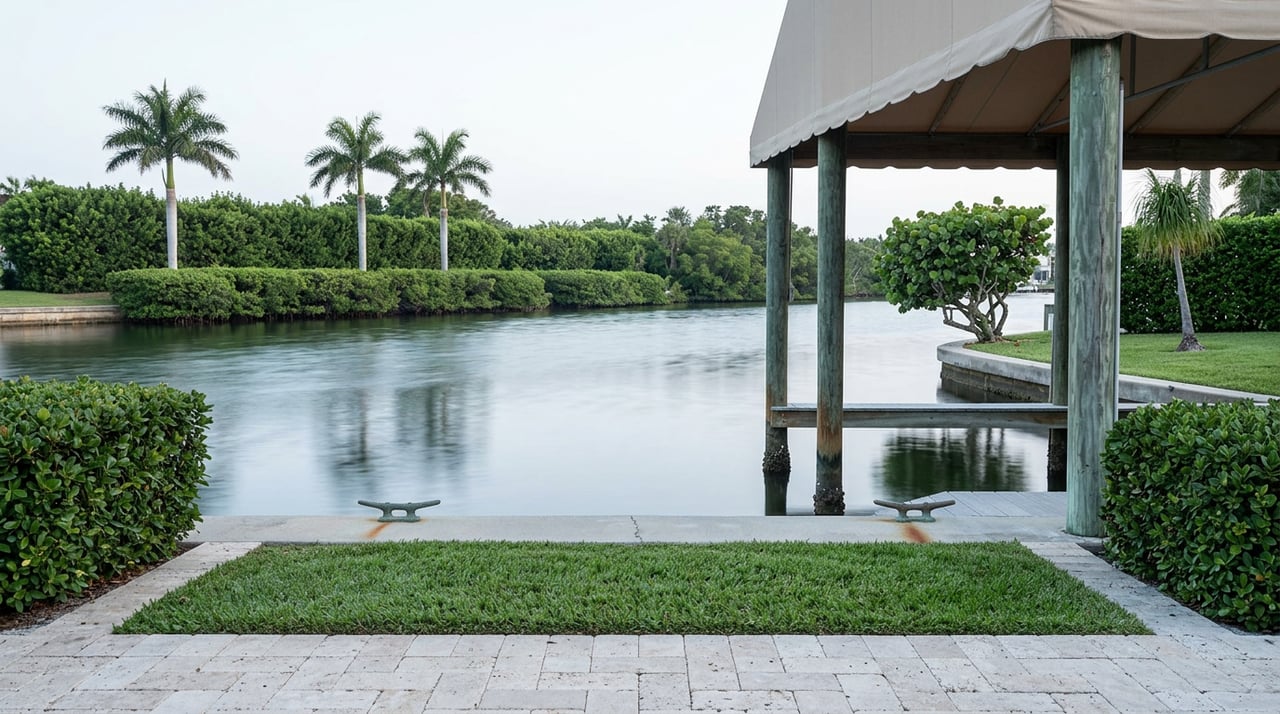
A buyer under contract on a canal-front lot this month walked the seawall at low tide with his inspector, watched the tide line expose a foot of cracked cap on the south corner, and asked the question almost every waterfront buyer asks eventually: doesn't my flood insurance cover this? The inspector's answer is the same one Naples marine contractors give every week. It doesn't, and it was never designed to.
That gap between what a flood policy protects and what an Aqualane Shores address actually delivers is worth understanding before you write an offer, not after you close. The house is not the product here. The unobstructed, no-bridge run from your dock to Naples Bay and Gordon Pass in under fifteen minutes is the product, and the wall and dock are the physical mechanism that makes it possible. A standard dwelling flood policy insures the structure of the home. It was built to protect a building against rising water. Seawalls, bulkheads, docks, and similar exterior marine structures sit outside that scope by design, not by oversight. This is standard National Flood Insurance Program language, not a Naples quirk, but it lands differently in a neighborhood where the wall is doing more work than almost anywhere else in the city.
Why the gap shows up here more than most places
Aqualane Shores was platted starting in 1949, the same year Naples became an official city, and the first homes were finished the following year. A meaningful share of the neighborhood's marine infrastructure has already lived through seven decades of tidal flow and storm cycles. Concrete and well-built vinyl or composite seawalls generally hold up for 30 to 50 years with regular maintenance. Older timber walls, more common on the earliest lots, tend to run a shorter 10 to 30 year service life. When a buyer is looking at a property with original or early-generation infrastructure, the seawall's remaining service life is not a footnote. It is a line item that belongs in the negotiation.
This is also where the market data gets interesting, and where the usual median-price summary stops being useful. As of March 2026, Aqualane Shores homes were selling at a median of roughly $10.3 million, with average days on market climbing to 105 from 57 a year earlier. A separate tracker this year put the median list price closer to $11.9 million with roughly 125 days on market, and a June 2026 snapshot showed a median listing price near $12.45 million with a median of 145 days on market. Those numbers do not disagree because someone is wrong. They disagree because so few transactions close in this price band in any given quarter that a handful of sales can swing the median in either direction, and a home's individual condition, particularly its wall and dock, carries far more weight in that small sample than it would in a larger, more liquid market. In a neighborhood this thin, structural unknowns do not average out. They show up directly in the number a buyer is willing to sign.
The district line that splits the neighborhood down the middle
Here is a detail that surprises even buyers who have done their homework. The City of Naples created the West Naples Bay Special Taxing District specifically for canal maintenance, including dredging, seawall inspection coordination, and cleanup of surface water pollution. That district covers the canals within Aqualane Shores, but it does not include properties that face Naples Bay directly. Two homes a few lots apart can carry a different maintenance and assessment profile depending on which side of that line they sit on. Before you go under contract, it is worth confirming whether the specific parcel falls inside the canal-maintenance district, whether any dredging has been scheduled or recently completed on that canal, and whether a special assessment is attached to it. None of this changes what makes Aqualane Shores worth the premium. The deep water, the no-bridge access, and the short walk to Third Street South's restaurant row, including The Continental, Campiello, and Osteria Tulia, are still the draw. It just means the diligence has to match the value at stake.
What the pier project put on the table this year
The Naples Pier rebuild, immediately adjacent to the neighborhood, is active right now, and its timeline has slipped. After a Florida Department of Environmental Protection final order in November 2024, a supplemental biological assessment submitted in April 2025, and FEMA's confirmation in May 2025 that the project qualifies for in-kind replacement, the City extended its completion target to November 15, 2026. That extension has put marine permitting, insurance renewals, and seawall condition squarely on the neighborhood's agenda this year, whether or not any individual buyer planned to think about it. Anyone under contract on a canal-front home right now is effectively closing during an active municipal marine construction window a few blocks from their new dock, and that is a fair thing to ask your agent and your insurance carrier about before you sign anything.
The permit fee is not where the real cost lives
It helps to separate two very different numbers. The City of Naples charges a modest fee to permit marine work: roughly $0.30 per square foot with a $100 minimum, plus a plan review fee equal to 20 percent of the permit cost, according to the city's own seawall permit fee schedule. That is not where the financial exposure sits. The exposure lives in the repair or replacement bill that follows once a wall starts failing, and given the age of infrastructure across parts of this neighborhood, that is not a hypothetical for every buyer who walks through. If your seawall was permitted decades ago, any repair or replacement work triggers a new permit review under current Collier County and City of Naples standards, and most structural work on panels, caps, or tie-backs requires that permit regardless of the wall's age. A wall that has quietly done its job for forty years can still require full modern permitting the moment you touch it.
What to confirm before you write an offer
A short list is worth more here than a long one. Before your due diligence period closes, confirm:
- Seawall material, approximate age, and any documented repairs or replacements
- Dock permit status, including any variances and whether the dock or lift is grandfathered
- Whether the parcel sits inside the West Naples Bay Special Taxing District's canal-maintenance boundary, and whether any assessment is pending
- Flood zone designation for the specific address
- Whether your insurance carrier offers a separate rider or endorsement for the seawall and dock, since coverage options and pricing vary and this needs to be confirmed in writing during your due diligence window
None of this diminishes what makes the neighborhood worth the wait. It simply means the paperwork underneath the dock deserves the same attention as the finishes inside the house.
FAQ
Does flood insurance cover my seawall or dock? No. A standard NFIP dwelling policy protects the structure of the home. Seawalls, bulkheads, and docks are excluded by design, and this is standard policy language rather than a local exception.
Where can I find details about seawall and dock repair? The Association coordinates community matters and communicates neighborhood updates; check the deed and any applicable association documents for details.
What happens if I repair or replace a decades-old seawall? Any repair or replacement work triggers a new permit review under current Collier County and City of Naples standards, and this applies to most structural work on panels, caps, or tie-backs regardless of the wall's age.
Can I insure the seawall and dock separately from my flood policy? Speak with your insurance agent about a specific endorsement or rider under your homeowner's policy. Coverage and pricing vary by carrier, so this is worth confirming in writing before your due diligence window closes rather than assuming it exists.
If you are weighing a purchase or preparing to list a canal-front property in Aqualane Shores, J2 Luxury Group can walk you through the building and lot-level diligence that matters here before you write an offer. Discover Elevated Living, and schedule a private consultation before your next showing.
This article is general information, not legal, tax or financial advice. Consult a qualified professional about your situation.